Replace the PDF: Use MicroCourses to Increase Completion, Recall, and Opt-ins
Learn why passive PDFs underperform and how microlearning with quizzes boosts engagement and retention for lead generation.
What you'll learn
- Identify the 3 failure points of PDFs: low open rate, low completion, weak behavior data
- Define a “microcourse” as 3–10 focused lessons designed for mobile completion in under 10 minutes total
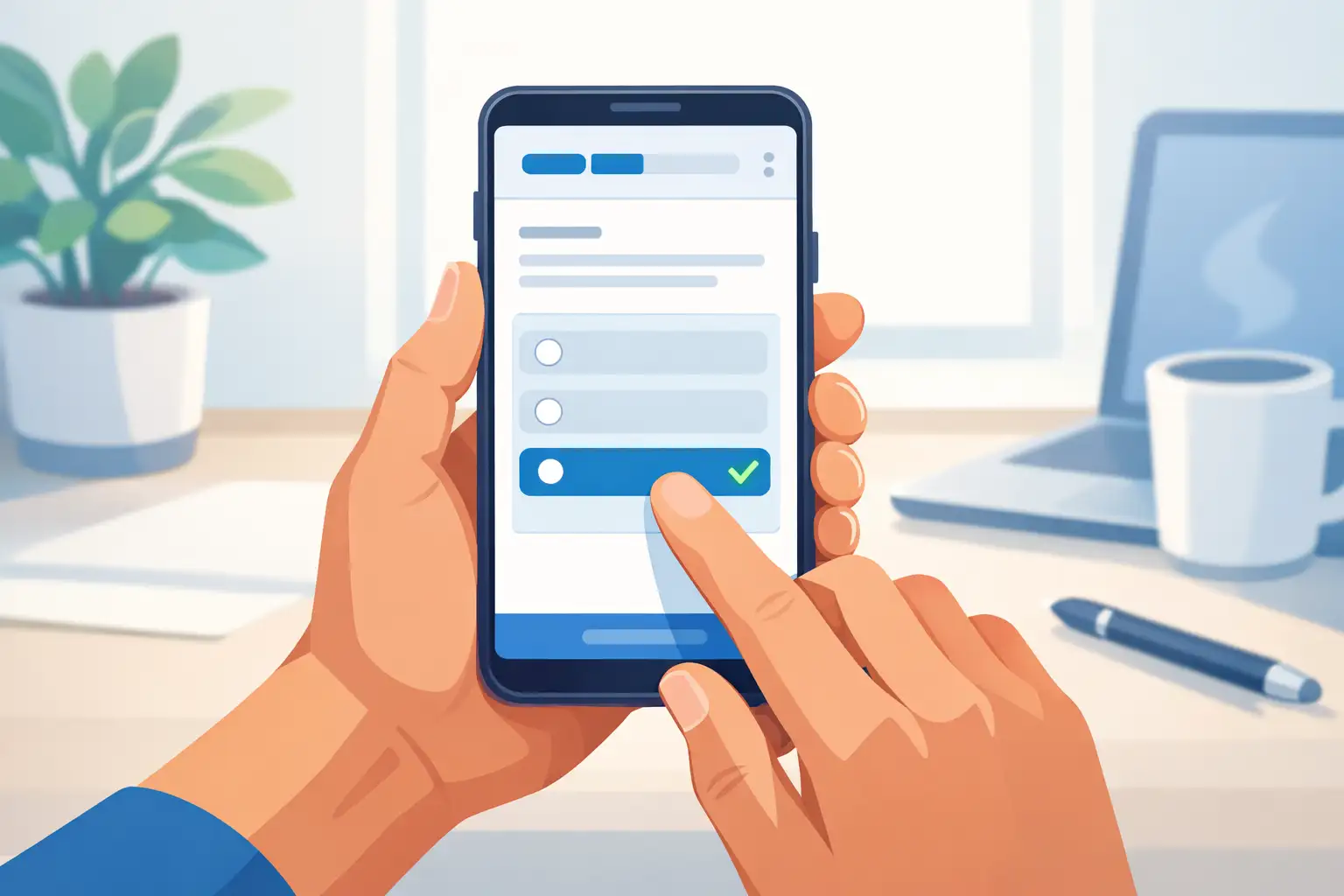
- Use quick quizzes to create retrieval practice (the #1 reason learners remember what you teach)
Module 1
Most PDF lead magnets fail for predictable reasons: they’re passive (no decisions required, no activity required), easy to postpone (“I’ll read it later”), and hard to finish on mobile. Even if the content is good, often people will skim and never actually get any benefit from it.
A micro-course solves this by requiring less commitment and encouraging more action. Instead of one long download, you deliver focused, mobile-friendly lessons with a clear start and finish. Adding short quizzes creates “retrieval practice”- the act of pulling information from memory - which dramatically improves recall compared to rereading. Progress tracking also gives the learner a reason to continue: they can see how close they are to done.
The bite sized nature prevents the learner from getting overwhelmed and also encourages completion - people's attention span has become shorter for online tasks so the interactive nature of these courses keeps people engaged.
Practical example: If your audience struggles with “email welcome sequences,” don’t offer a 25-page guide.
Create a 3-lesson microcourse:(1) Pick one goal for your welcome sequence,
(2) Outline the 3-email structure,
(3) Write strong subject lines.
Set the timing and triggers—each lesson includes a 1-question quiz.
Common mistake: calling a chopped-up PDF a “microcourse” while keeping it text-heavy and non-interactive. If nothing requires a response, people still skim or bounce.
What to do next: pick one existing PDF lead magnet and list its main promise in one sentence. Then rewrite that promise as a single outcome the learner can achieve quickly (within a week, ideally a day).
That outcome becomes your microcourse’s core job.
Quick Check
What is the biggest conversion advantage of adding a short quiz to each micro-lesson?
Recap
- PDFs are passive and hard to finish; microcourses are short and action-driven.
- Quizzes improve retention by forcing retrieval, not just reading.
- Progress and completion turn your lead magnet into an experience, not a file.
Plan a One-Problem MicroCourse: Choose the Pain Point and Outline 4 Lessons That Flow
Choose a single pain point and outline four short, outcome-focused lessons that logically build from setup to result.
What you'll learn
- Use the “One Problem → One Promise” rule to prevent scope creep
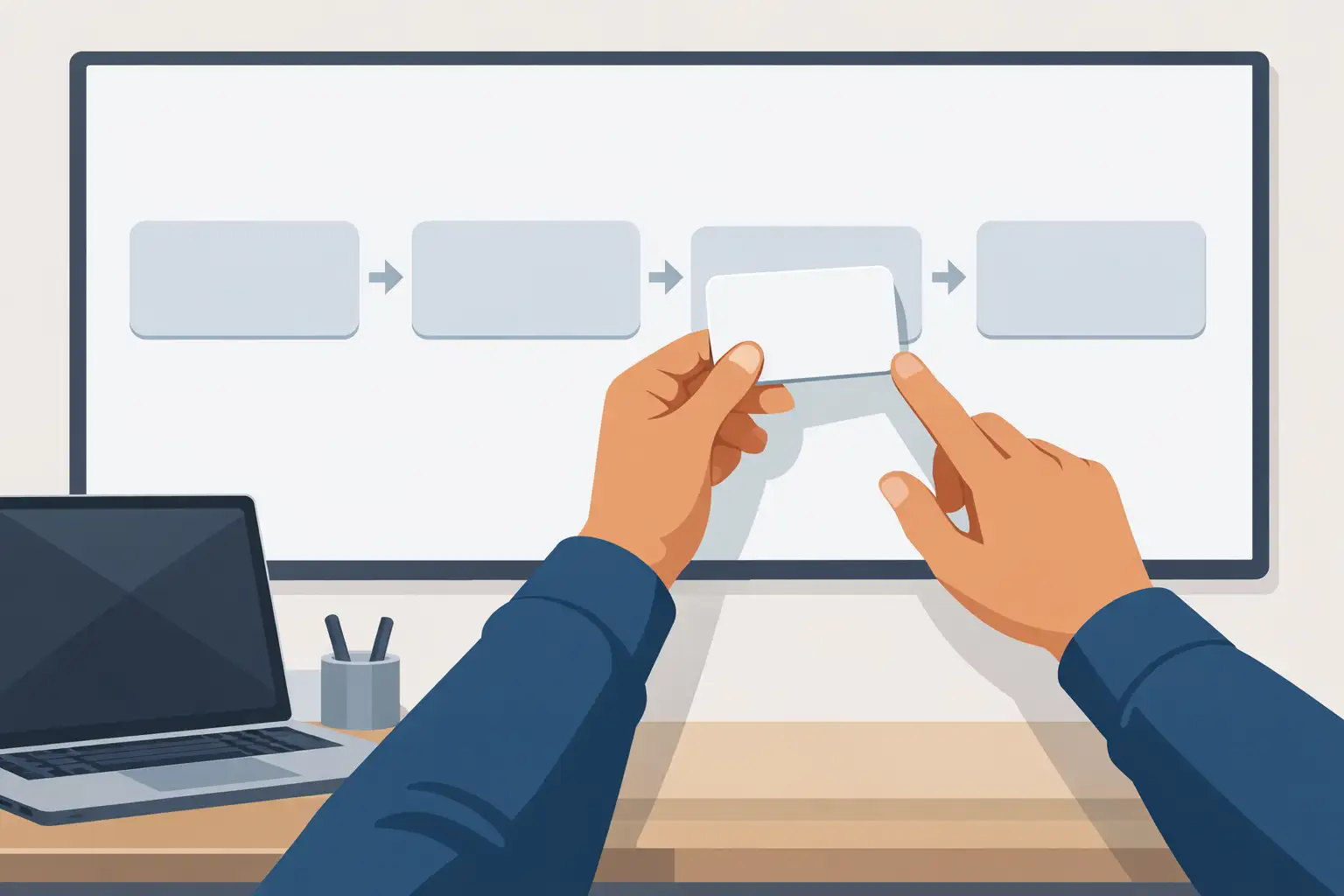
- Outline 4 lessons: Foundation → Understanding → Application → Refinement/Next step
- Write each lesson around one action the learner can complete in 10 minutes or less
Module 2
High-converting microcourses solve one problem, not a whole topic. “Facebook ads” is a topic; “Write your first high-intent ad angle” is a problem/solution.
The tighter the promise, the easier it is for someone to finish—and finishing is what makes your lead magnet feel valuable.
A simple planning method: start with a single end result (“By the end, you’ll have X”). Then outline four lessons that stack. Lesson 1 sets the foundation (definitions, constraints, what good looks like). Lesson 2 builds understanding (how the parts work together, why people get stuck). Lesson 3 is application (do the thing, step-by-step). Lesson 4 is refinement and next steps (check quality, troubleshoot, connect to what’s next).
Practical example for course creators: Promise: Create a welcome email sequence that builds authority and trust.
Lesson 1: The Job of a Welcome Sequence
Lesson 2: The Trust-and-Authority Framework Explained
Lesson 3: Writing the 4-Email Welcome Sequence Using What We Have Learned
Lesson 4: Polish, Automate, and Make It Convert
These lessons should include quick fun "knowledge tester" quizzes and recaps before moving on to the next module.
At the end, there should be a clear call to action inviting people to take the next logical step.
Common mistake: stuffing “everything I know” into four lessons. That creates vague lessons and weak outcomes (“Learn the basics of…”). If you can’t describe what the learner will produce, you’re too broad.
What to do next: write your microcourse promise as: “In under (timeframe), you will (create/do) (specific deliverable) without (common obstacle).” Then draft four lesson titles that each end with a tangible output (a sentence, a checklist, a draft, a setup).
Quick Check
Which microcourse promise best follows the “One Problem → One Promise” rule?
Recap
- One microcourse should solve one specific pain point with one clear deliverable.
- Four lessons work best when they build: foundation → understanding → application → refinement/bridge.
- If a lesson doesn’t produce an output, it’s probably too broad.
Add Interactivity That Keeps Learners Moving: Quizzes, Recaps, Progress, and Simple Visuals
Design interactive elements that reduce mind-wandering and help learners remember and apply what you teach.

What you'll learn
- Write 1–2 question quizzes that check decisions, not trivia (use scenarios and “best next step” prompts)
- Add a 3-bullet recap at the end of each lesson to anchor the key points
- Use progress tracking plus one simple visual per lesson (framework diagram, checklist screenshot, or template)
Module 3
Interactivity is not decoration - it’s guidance. The goal is to keep learners making small decisions so they stay mentally present. When someone answers a question, they switch from passive consumption to active processing, which reduces mind-wandering and improves memory.
Start with quizzes. Keep them short and aligned to the lesson outcome. The best questions test judgment: “Which option best fits this situation?” or “What’s the best next step?” Avoid trivia that doesn’t change behavior.
Then add recaps: three concise takeaways that match what you actually taught. Recaps work as a mental “save point,” and they make your course easy to skim later.
Progress tracking matters because it creates a completion loop. A learner who sees 75% complete is far more likely to finish than someone staring at an endless page.

Practical example: In a lesson on choosing a course pain point, include a mini-framework image: “Problem → Cost → Quick Win.” Then a quiz question: “Which pain point is most suitable for a microcourse lead magnet?” End with a 3-bullet recap and show “Lesson 2 of 4 completed.”
Common mistake: adding too many interactive widgets (polls, sliders, branching) that slow down completion. If it’s a lead magnet, speed and clarity beat complexity.
What to do next: for each of your four lessons, draft (1) one quiz question tied to the lesson output, (2) a three-bullet recap, and (3) one visual idea that makes the lesson easier to understand in five seconds.
Quick Check
Which quiz question style best improves learning in a microcourse lead magnet?
Recap
- Quizzes should test decisions and understanding, not trivia.
- Recaps create a clear takeaway and make lessons easier to revisit.
- Progress + simple visuals increase completion without adding complexity.
Launch and Leverage Your MicroCourse: Publish as a Lead Magnet and Bridge to Your Paid Offer
Publish your microcourse as a free lead magnet, nurture subscribers based on progress, and connect the outcome to your main offer.
What you'll learn
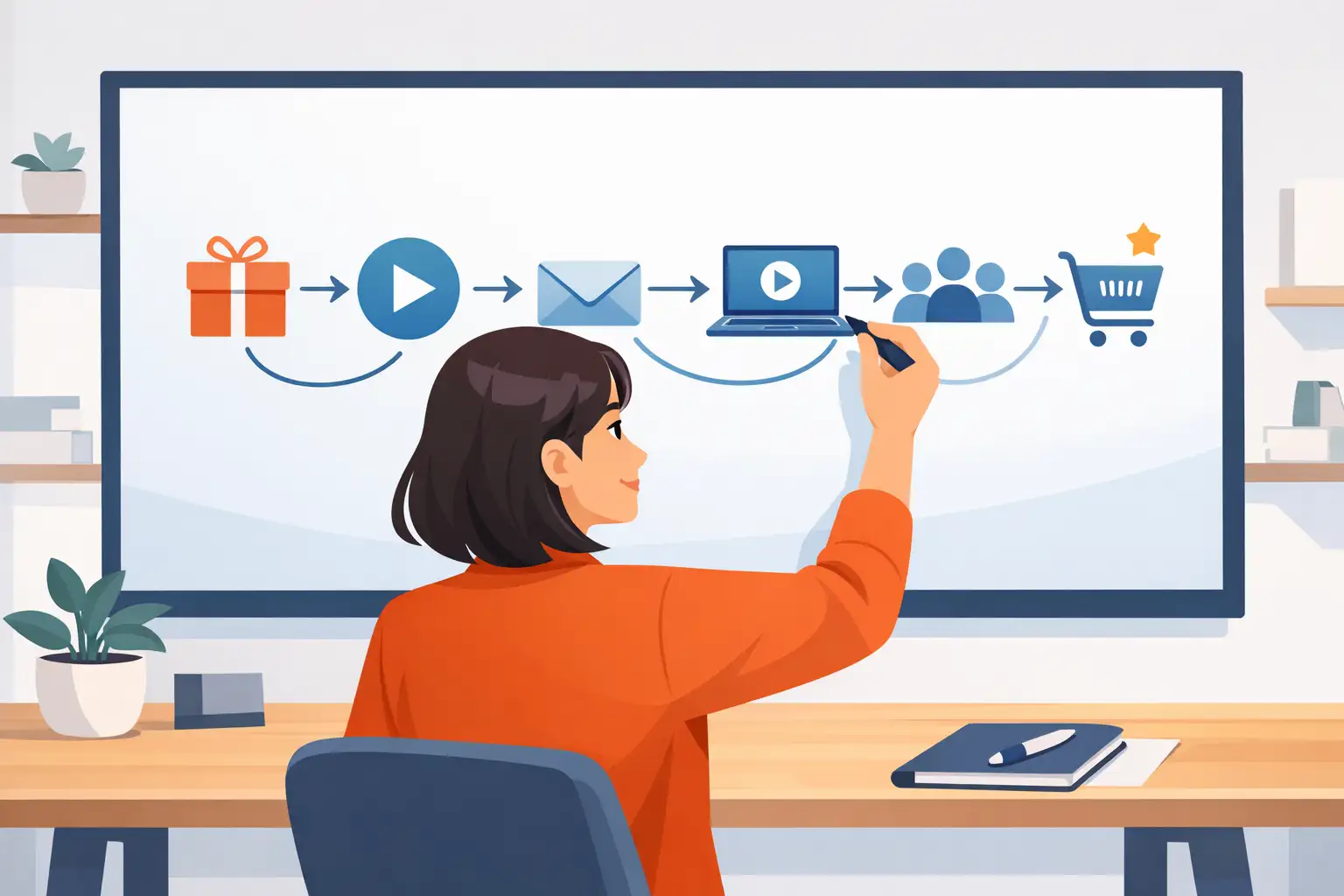
- Set up a simple funnel: opt-in page → microcourse → completion email → relevant next step
- Use behavior signals (started, completed, quiz results) to tailor follow-up messaging
- Write a bridge that feels natural: “If you want help implementing this at scale, here’s the next program”
Module 4
A microcourse converts when it’s positioned as a fast win that naturally leads to a bigger win. Your job is to make the microcourse complete on its own, then show what becomes possible if the learner wants deeper support.
Publish it like a product, not a file. Use an opt-in page that promises one clear outcome, then deliver the microcourse immediately. Your nurture should be behavior-based where possible: someone who starts but doesn’t finish needs reminders and friction removal; someone who completes is ready for an invitation. Even simple segmentation—Started vs. Completed—improves relevance.
Practical example: If your paid offer is a full training on “Copywriting for Emails - The Essentials” your microcourse might teach “Creating A Perfect Email Welcome Sequence,”
After completion, you could add a call to action on the final page. Now that you have mastered this important skill, take the next step to email writing mastery"
Common mistake: pitching too early or too broadly. If you sell in lesson 1, you reduce completion. If your pitch doesn’t relate to the microcourse outcome, it feels random and pushy.
What to do next: Create a call to action text that encourages the learner to take the next step. It should feel a logical thing to do and you need to make it compelling to encourage the learner to click the link to check it out
Quick Check
When is the best time to present a strong invitation to your paid offer in a microcourse funnel?
Recap
- Treat the microcourse like a guided experience: opt-in → learn → complete → next step.
- Completion is the moment to invite; non-completers need friction-reducing nudges.
- A strong bridge connects the microcourse outcome to the next bottleneck your paid offer solves.
Course Complete
You just finished the full Micro Course Blueprint- nice work. You now have a clear, repeatable way to plan, build, and launch interactive lead magnets that people actually complete.
Click the link below to transform your ideas and existing pdfs into fun, interactive courses today!
Use the button below to take the next step, or start over and run through the course again.
Use The Interactive MicroCourse App HereDownload the information in this course to keep and refer back to